

Research and Resources
Access the latest academic insight into complex climate topics
The University of Exeter is home to many innovative and important climate research projects, with over 1,500 climate and sustainability experts across 34 specialist environmental institutes and centres of excellence, including many of the world’s most influential climate scientists.
Some climate research is immediately intuitive and practical, informing action at all levels of scale from community groups to national governments. But some requires a process of translation, engagement, co-production, and recontextualisation before it can be used in practice.
These pages offer a shortcut into the latest climate research, with access to tools and resources, illustrations and videos, and hand-picked reports to provide the simplest route into what you need to know, now.
This list will continue to be updated over time, so keep checking back, and contact gfn@exeter.ac.uk if you have any questions or you think there should be other research showcased below.
Positive Tipping Points

A tipping point occurs when a change in a system becomes self-reinforcing, building momentum towards widespread, and often irreversible, impacts.
This way of thinking can help us understand systems change as a non-linear process, in which it can appear as though very little progress is being made, before a seemingly rapid and sudden transformation. In reality, the work that goes into creating the enabling conditions for change is just as important as the moment of tipping.
The University of Exeter’s Global Systems Institute, alongside others, has been pioneering research into tipping points in Earth Systems, including melting glaciers and ocean current collapse. More attention is now being directed at political, technological, and social systems.
These resources offer a comprehensive insight into the potential for positive tipping points, where rapid and vital change can occur in our attempts to respond to the interconnected crises we face.

The Positive Tipping Points Toolkit
The Positive Tipping Points Toolkit exists to make working with complex systems more accessible, rewarding, and collaborative.
At its simplest point, the Toolkit is a collection of tools which can be used to bring Positive Tipping Points to life, and apply the framework to your work for change.
But a list of tools can be overwhelming, so the Toolkit is also a map for navigating complex systems change, for yourself or others.

Positive Tipping Points in Practice
To support organisations, groups and individuals to apply the growing research into tipping points into their work, the Positive Tipping Points Community of Practice is an open monthly online space where we work through real-life examples of applying PTPs in practice.
All are welcome to join, view our upcoming events to find out more.
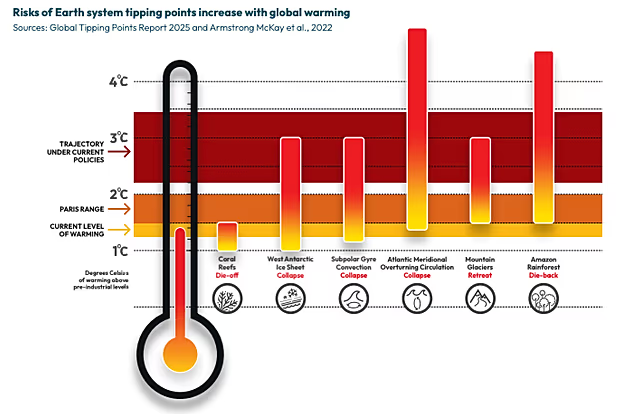
The Global Tipping Points Report
This report brings together the latest research on tipping points – both positive and negative, with contributions from 160 authors, from 23 countries and 87 institutions.
It consolidates knowledge on how to govern Earth system tipping points, the risks they pose, and the opportunities presented by understanding and acting on positive tipping points.
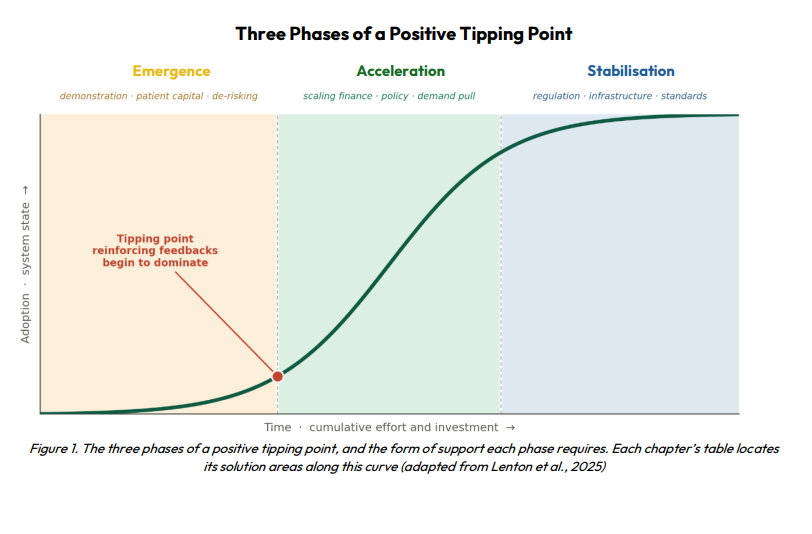
The Positive Tipping Points Playbook
Released in September 2026, this report from The Earthshot Prize and the University of Exeter’s Green Futures Solutions team reveals 51 environmental solutions that can trigger rapid and transformative change to repair our planet within the next five years.
Positive Tipping Points videos
Climate Adaptation

Using our growing understanding of the current and future impacts of climate change requires a complex combination of skills, capacities, and resources. This includes access to the latest available climate data, new stories to tell about the future, hearing from diverse perspectives including those with lived experience of climate impacts, and the ability to navigate complexity and uncertainty.
The University of Exeter has a variety of resources and research themes to support organisations, groups, and networks to understand adaptation, and take informed action in a rapidly changing world.
LCAT (the Local Climate Adaptation Tool)
LCAT is a free evidence-based decision support tool to explore how local climates will change, what the impacts may be, who will be vulnerable, and which adaptations to consider.
Adaptation Community of Practice
The Adaptation CoP is a free, open network for anyone working in or around adaptation. We meet monthly to share good practice, discuss live questions, and acknowledge systemic challenges.

Beavers as ecosystem engineers
What impact do beavers have on their environments? Can they actually play a role in natural flood management? This artwork by More than Minutes illustrates research by the University of Exeter’s Dr Alan Puttock, working with the Cornwall Wildlife Trust, Devon Wildlife Trust and others.

CLIMAR: climate change risks
The Climate Impacts, Mitigation, Adaption and Resilience (CLIMAR) Framework tool is a crucial tool in designing pathways to NetZero and enhancing resilience to climate change.
Created with the Met Office, CLIMAR creates decision-ready information on climate impacts for policy makers, industry and the public.
CLIMAR uses Data Science and AI to quantify and visualise the risks on populations, infrastructure and the economy.

Changing Places Storymap
This storymap is a living, growing archive of places where people are developing the skills to work with dynamic change, rather than resist it.
It is a project of the Adaptive Heritage Practice Lab (AHPL), a community of researchers and practitioners united by a shared interest in how we can care for places and things that are coming apart – and coming together again – in unpredictable ways.
Climate Adaptation videos
Personalised Ecologies

Personalised Ecology is a model for better understanding the interactions between individual people and their ecological surroundings. It can help us move beyond an objective view of the natural world and instead to examine and explore the nuances in how those interactions inform our experiences and relationship with nature.
The Green Futures Network is leading a collaborative process to explore how this framework can be applied in practice, for groups and organisations working on deeper engagement with the natural or non-human world.
Personalised Ecologies Huddle
This 7-month co-creation process will end in April 2027, with a showcase event to share the collaborative resources and ideas to use the framework in practice.

Personalised Ecologies research
The framework comes from the RENEW project (Renewing biodiversity through a people-in-nature approach). Its focus is on a ‘people-in-nature’ approach, reflecting the two-way, dynamic relations between people and nature and the need to develop a relational approach to renew our life-support systems.
Discover reports, case studies, resources and more on the project website.
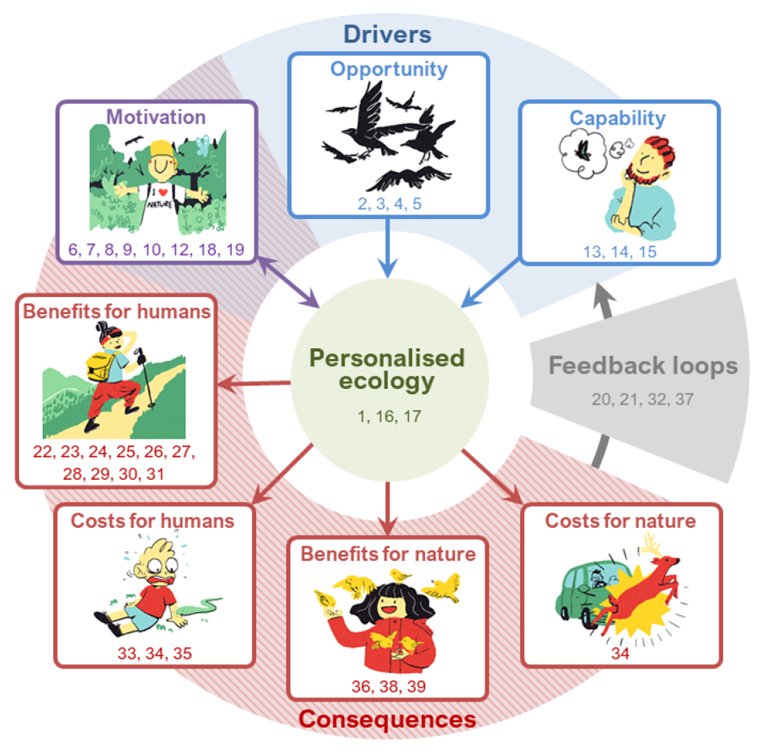
The Personalised Ecology Index
The Personalised Ecology Index (PEI) is designed to measure the many ways a person directly interacts with nature through their senses, as a single score.
The PEI measures four dimensions of nature interaction: how often people visit nature (frequency), how long those visits last (duration), how varied the types of natural spaces visited are (diversity), and how much attention they pay to elements of nature (intensity).

Domesticating Rewilding
Why are so many rewilding projects in England avoiding ‘the R word,’ and what can it tell us about a unique form of English rewilding that is emerging?
This research illustration outlines why ‘Rewilding’ is such a polarising idea and a polarising word. For some it is threatening and alienating, for others it presents a hopeful narrative for the future of conservation and ecosystems.
Personalised Ecologies videos
Data & Net Zero
The science is clear, our current carbon emissions are incompatible with our current way of life. Many targets have been set, few of them have been met. It is vital that we can both stay up to date with the latest data into what needs to be done, as well as research into how we can take action right now.

Global Carbon Budget
The Global Carbon Budget is the critical annual update revealing the latest trends in global carbon emissions from the University of Exeter with the support of more than 100 people from 70 organisations in 18 countries.
Since 2006, it has provided a wealth of information on carbon emissions and the ramifications for reaching the global climate goals.
Centre for Environmental Intelligence
The Centre for Environmental Intelligence is an interdisciplinary research centre using responsible AI and data science to address urgent environmental challenges. It works with leading partner organisations to improve decision-making and enable innovation across climate, biodiversity and sustainability.
Scope 3 Community of Practice
Many organisations have developed methods to measure their Scope 1 and 2 emissions, but Scope 3 (emissions from things we do not own, or those in our value chain) is much harder. This Community of Practice is for organisations across the UK, as we work to find opportunities for consistency in how we understand and measure our Scope 3 carbon emissions.

Centre for Climate Communication & Data Science
The Centre for Climate Communication & Data Science’s (C3DS) research aims to improve strategic communications to deliver meaningful action on climate change. They monitor, evaluate, and analyse the ways in which the modern information environment promotes or hinders comprehensive climate action.
Data & Net Zero videos
Climate Disagreement

Communities, organisations, and individuals are increasingly having to navigate the impacts of environmental change and the difficult decisions that come with adapting to such changes. Cutting across debates around land use change, energy infrastructures, nature recovery, and other place-based interventions are themes of trust, inequality, inclusion, (mis)information and the role of knowledge. Debates are becoming more visible, more complex, and more contested.
How can we navigate these social and political systems, and how can disagreement be a force for good, driving inclusive and innovative new policies and developments that ensure a better world for all?
Climate Disagreement Community of Practice
This Community of Practice asks how constructive disagreement become a catalyst for better governance, more meaningful participation and a more sustainable future?
Governing Sustainable Futures
Governing Sustainable Futures (GSF) is a project funded by the Economic and Social Research Council (ESRC) that seeks to uncover why certain environmental topics spark controversy and how we can improve discussions around these pressing issues.

The Co-Production Oracle
The Co-production Oracle, a deck of 30 cards which can be used by groups, pairs or individuals to create a space to think and reflect without needed a resolution, is a technology to disrupt your ideas.
View an overview of the tool, or access an online version for free.
Edit for Climate Change
With 324 million annual page views across over 25,000 climate articles, Wikipedia is one of the biggest sources of information on climate change in the world and relies on volunteer editors to keep articles up to date.
GSI has partnered with Wikimedia UK to update climate research on Wikipedia, making research accessible, filling knowledge gaps and combating climate misinformation in the process. This article, Effects of climate change on health in the United Kingdom, was written collaboratively by over 20 researchers from UK universities and health institutes.