

Personalised Ecologies Huddle
Learn from the latest research into understanding our relationship with nature, and co-develop a practical approach to using it in your work on nature engagement, protection, and restoration
Overview
Personalised Ecology is a model for better understanding the interactions between individual people and their ecological surroundings. It can help us move beyond an objective view of the natural world and instead to examine and explore the nuances in how those interactions inform our experiences and relationship with nature.
This free, 6 month participatory process will outline the latest research into Personalised Ecologies, and invite you to help shape how that research can be applied in practice to organisations and individuals who are working to increase our engagement with the natural world.
The Huddle is now full, but you can read more about the details below, and if you would like to stay in touch with the outcomes from the process then please email Peter at gfn@exeter.ac.uk.
What is a Personalised Ecology?
It can be simply described as the direct (especially sensory) interactions that each of us has with nature.
- We all have one
- They are unique
- They ebb and flow over time (short and long-term)
- They will be different in different parts of our lives (e.g. weekend, weekday)
You can read more about the idea in this academic paper from 2018.
What is a Huddle?
Huddles are an ecosystem of support for peer-led learning and action, developed by Huddlecraft. It is a process that has already been used by the Green Futures Network to develop the Positive Tipping Points Toolkit. You can read about participants’ experience of the Huddle process in blogs here and here.
If I hadn’t huddled, I would never have had the courage to go for this project and this piece of funding in the way that I am now.
I’ve met some lovely people. And in terms of my life and shifting career, it gave me a language to build and share it on.
Who is this for?
This opportunity is for you if:
- You work to support the restoration of, or engagement with, nature.
- You thrive when learning with others.
- You are energised by exploring the complexity of how we experience the world around us.
You might be a facilitator or coach, keen to apply Personalised Ecologies to your work. Or perhaps you are part of an organisation or group working to support others to engage with nature, and looking to find new tools and frameworks to support this.. We will all bring our own stories of change to this work, and collectively test and refine our applications of the research into something that can be opened out into the wider world.
Meeting every two weeks, we will start with a journey through the latest research into Personalised Ecologies, and the wider work it is rooted in, before reshaping it into something new. We will begin with getting to know each other, and our own stories of working in, with, and as part of nature, using Personalised Ecologies as a guide. Over the following months, we will each have the chance to take an aspect of the framework – which could be something missing – and work on it in our own contexts. Towards the end we will bring it all together, with the opportunity to share what we have created with a wider audience.
FAQs
- How do you approach diversity and inclusion?
We believe that placing peer-to-peer relationships at the heart of learning creates huge potential for a more inclusive approach to education. We also know that a very deliberate effort is required to deliver those benefits in reality. A key part of this process is that participants learn alongside people they wouldn’t otherwise have met and are able to exchange their perspectives, ideas, experiences and more. - How much does it cost?
Nothing! This process is free, and funded by the University of Exeter as part of participatory research. - What am I committing to?
2 hours every 2 weeks, plus a commitment to developing and testing ideas outside of the sessions, in your existing work - Do I need to be a facilitator to take part?
No, although some kind of role in engaging others is important. This could be through your work or a group you are part of. You’ll need to be willing to run a meeting or workshop with others, although it’s also an opportunity to get more comfortable, and you’ll be supported!
How to get involved
Applications are now open, and you have until 19 July 2026 to complete the application form.
Here are some other resources which you may find useful:
- A recording of the info session
- Peter’s slides from the info session
- The info page for the Huddle on the Huddlecraft directory
- A Huddle info pack with more about the process
- For anyone thinking about their Learning Question, Huddlecraft have written a great blog called How to find your Learning Question (and why you should) which is well worth a read!
- Find out more about the Positive Tipping Points Huddle here
- Further reading on Personalised Ecologies (N.B. It’s not required that you read these):
- https://www.sciencedirect.com/science/article/pii/S0169534718302337
- https://www.cambridge.org/core/journals/cambridge-prisms-extinction/article/personalised-ecology-and-the-future-of-biodiversity/CBFA29AA5702FA136C45D9819E2445AF
- Reconnecting People to Nature Across Society to Shape the Future of Biodiversity (pdf download)
- Health benefits of viewing nature through windows: A meta-analysis (pdf download)
- https://besjournals.onlinelibrary.wiley.com/doi/pdfdirect/10.1002/pan3.70189
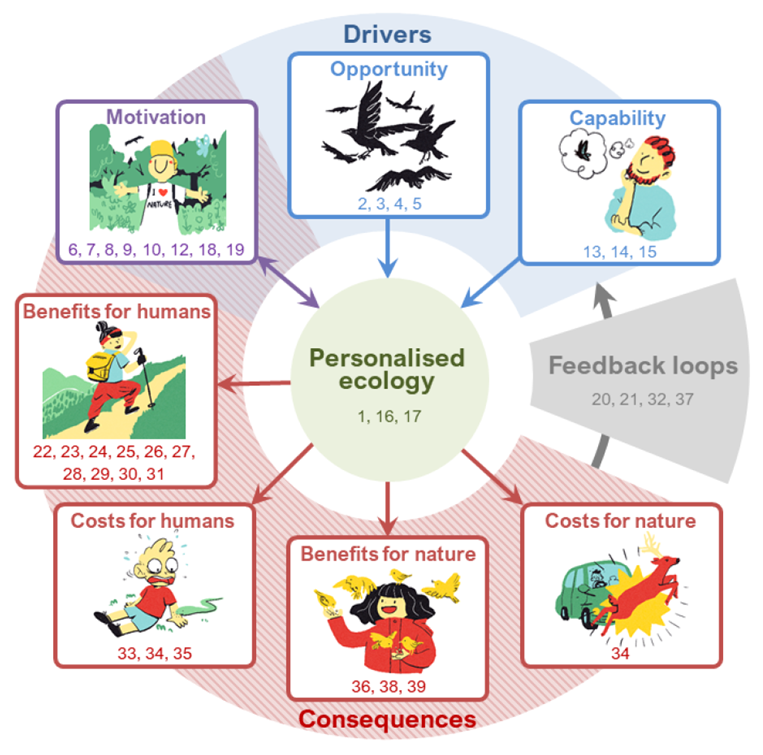
Image source: Masashi Soga & Kevin Gaston (2021)